
2026 Spring Issue
Statistics Reimagined for Discovery and Decision-Making

Note from the Editor:
Welcome to the Spring 2026 Issue! This year’s theme is “Statistics Reimagined for Discovery and Decision Making”, and the articles in this issue showcase how our community is pushing the boundaries of statistical thinking to shape the future of medicine development.
We open with the BIOP 2025 Chair Transition Report from Steven Novick and Erik Bloomquist, capturing a year of remarkable achievements and previewing plans for 2026.
A central thread in this issue is the evolving relationship between AI and statistical reasoning. Yanxun Xu explores how AI is transforming the statistical workflow in healthcare — serving as a force multiplier for rigorous thinking, not a replacement. Jingyun Jia and Ben Lengerich highlight the complementary roles of machine learning and causal inference, while Antonio Remiro-Azócar features machine learning for comparative effectiveness research. Jinfeng Zhang argues that generative AI’s true power depends on structured knowledge and quantified uncertainty.
Regulatory perspectives are well represented. Susan Mayo draws on her dual industry and FDA experience to discuss statistical frameworks — from estimands to benefit-risk planning — that improve drug development clarity. We also continue the Project SignifiCanT series with two new regulatory discussion summaries: one on interpreting duration of response in cancer trials, and another on the challenges when the standard of care changes during ongoing randomized trials.
Scott Evans offers a thought-provoking reflection on the opportunities and threats facing clinical trials. In operational innovation, Fei Chen and the Efficiency+ Scientific Working Group show how statisticians are bringing statistical modeling to trial operations — from drug supply to site selection. The openstatsware group shares updates on open-source software, including the relaunched CRAN Task View for Clinical Trials and the new openstatsguide.
Career development is a highlight of this issue. Aloka Chakravarty reflects on three decades spanning FDA, academia, and industry with guidance on navigating sector transitions. The team at The Lotus Group shares a candid letter — Cracking the Industry Code — with practical advice on what hiring managers really evaluate beyond technical skills.
We proudly announce the 2026 Student Paper Award winners, whose work spans IPD reconstruction, treatment effects with competing intercurrent events, and nonconcurrent data integration in platform trials. Congratulations to all the winners.
We round out with the recap insights by Wanjie Sun and colleagues from FDA, EMA, and industry leaders on statistical innovation from the 2025 RISW plenary panel, the STATBOLIC 2026 Conference Report, documenting the growth of this cardiometabolic forum to nearly 190 attendees, and a comprehensive Upcoming Conferences column highlighting MBSW, JSM in Boston, the Regulatory-Industry Statistics Workshop, and more.
Our sincere gratitude to all contributors for sharing their expertise, and to our ASA colleagues for their continued support in production. We hope this issue inspires fresh thinking as our community reimagines what statistics can achieve.
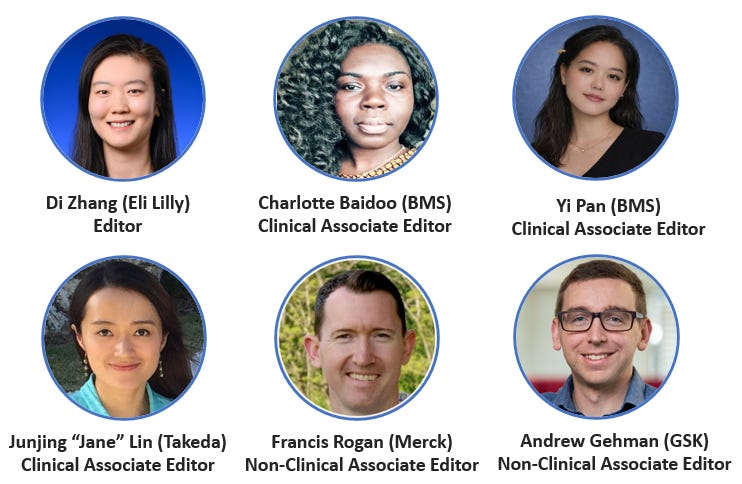
2025 ASA Biopharmaceutical Report Editorial Board:
Di Zhang (Eli Lilly, Editor), Charlotte Baidoo (BMS, Clinical Associate Editor), Yi Pan (BMS, Clinical Associate Editor), Junjing “Jane” Lin (Takeda, Clinical Associate Editor), Francis Rogan (Merck, Non-Clinical Associate Editor), Andrew Gehman (GSK, Non-Clinical Associate Editor)
ASA Biopharmaceutical Section Chairs:
Erik Bloomquist (2025), Steven Novick (2026), Judy Li (2027)
Transition Report
BIOP 2025 Chair Transition Report
Steven Novick (Takeda), Erik Bloomquist (Neurocrine)
Featured Articles on Theme
Machine learning for comparative effectiveness research: What is the catch?
Antonio Remiro-Azócar (Novo Nordisk)
From Data to Evidence: How AI Is Transforming the Statistical Workflow in Healthcare
Yanxun Xu (Johns Hopkins University)
Structured Knowledge with Quantified Uncertainty: Unlocking the True Power of GenAI
Jinfeng Zhang (Insilicom)
AI Finds Patterns. When Do They Become Evidence?
Jingyun Jia (UW-Madison), Ben Lengerich (UW-Madison)
Susan Mayo (FDA)
Leadership and Career Development
Seizing the Opportunities in and Protecting the Integrity of Clinical Trials
Scott Evans (George Washington University)
Aloka Chakravarty (Eli Lilly and Company)
Cracking the Industry Code: A Letter to Future Biostatisticians Entering the Pharmaceutical Industry
Bill Emker, Lei Wang, Helena Fan & Dean Grimm (The Lotus Group)
Working Group and Conference Update
ASA Biopharmaceutical Section Student Paper Awards
Francis Rogan (Merck)
Andrew Gehman (GSK)
Wanjie Sun (FDA), Mark Levenson (FDA), John Scott (FDA), Gregory Alexander (FDA), Florian Lasch (EMA), Li Wang (AbbVie), Devan Mehrotra (Merck), Jared Lunceford (Merck)
STATBOLIC 2026 Conference Report
Hiya Banerjee (Eli Lilly), Henrik Ravn (Novo Nordisk), Yingwen Dong (Roche) on behalf of STATBOLIC Working Group
How Many Vials for Brazil? Efficiency+ Brings Statistical Innovation to Trial Operations
Fei Chen (Johnson & Johnson) on behalf of the Efficiency+ Scientific Working Group
Rajeshwari Sridhara (FDA), Olga Marchenko (Bayer), Qi Jiang (Pfizer), Brittany McKelvey (LUNGevity), Yiyi Chen (Pfizer), Gautam Mehta (FDA), Richard Pazdur (FDA)
Rajeshwari Sridhara (FDA), Gautam Mehta (FDA), Olga Marchenko (Bayer), Brittany McKelvey (LUNGevity Foundation), Qi Jiang (Pfizer), Yiyi Chen (Pfizer), Richard Pazdur (FDA)
openstatsware: Recent Highlights and Ongoing Work
Daniel Sabanés Bové (RCONIS), Alessandro Gasparini (Red Door Analytics), Ya Wang (Gilead Sciences)